
For the modern expansionist, the choice of a regional headquarters has evolved from a simple question of geography or lifestyle. It is a complex exercise in structural arbitrage; balancing the imperative of market scale against the cost of operational friction.
In the early phases of African expansion, the "headquarters question" was often treated as an administrative afterthought. Global multinationals typically defaulted to a "hub-and-spoke" model, anchoring in Johannesburg for its financial maturity or managing operations remotely from London or Dubai to bypass continental volatility. The logic was defensive: prioritize institutional safety and manage the "frontier" at arm's length.
In 2026, this defensive posture is no longer a viable strategy. The assumption that Africa can be served effectively from the outside—or from a single, disconnected hub—is obsolete. The continent has shifted from a "final frontier" to an active, competitive landscape shaped by demographic acceleration and digital integration.
For companies like “NovaCorp”—and indeed any firm seeking meaningful returns—the decision of where to sit is the single most consequential structural decision they will make. It determines the rhythm of decision-making, the efficiency of capital deployment, and the organization's resilience against shock.
The dilemma facing executives today is sharp: The markets with the deepest institutional stability often lack growth, while the markets with the greatest scale often carry the heaviest operational tax. Resolving this tension requires moving beyond "planting a flag" to designing a jurisdictional strategy that uses structure to mitigate risk.
The Efficiency Paradox: Scale vs. Sanity
When evaluating the "Big Five" priority markets—Nigeria, South Africa, Egypt, Kenya, and Morocco—investors are typically forced to trade Institutional Depth for Market Scale.
1. The Stability Trap: South Africa
South Africa has long been the default entry point. It offers "institutional depth," sophisticated financial markets, and a legal system that global general counsels find comforting. It ranks 84th globally for ease of doing business—significantly higher than its peers—and serves as the natural gateway to the Southern African Development Community (SADC).
However, this stability masks a growth ceiling. The economy is forecasted for sluggish growth (0.5% in 2024), constrained by a persistent energy crisis and policy volatility. While it remains ideal for complex financial services requiring deep capital markets, it is increasingly detached from the continent's consumption engine. Anchoring a pan-African consumer strategy in Johannesburg is structurally misaligned; it provides safety, but at the cost of proximity to the volume markets.
2. The Scale Imperative: Nigeria
On the other end of the spectrum lies Nigeria. With a GDP of $252.1 billion (2024) and a population exceeding 232 million, it is the continent’s undeniable demographic heavyweight. It offers access to the 380-million-strong ECOWAS market and a consumer potential that no other African nation can match.
Yet, this scale is "taxed" by significant friction. Investors must navigate foreign exchange volatility, regulatory inconsistency, and infrastructure gaps. In the Operating Playbook, experts note that while Nigeria offers the perfect market size, it demands disciplined navigation of red tape and currency risks. For decades, this friction forced a binary choice: enter Nigeria and accept the chaos, or stay out and miss the growth.
3. The Innovation Hub: Kenya
Kenya offers a "middle path." As the "Silicon Savannah," it boasts a pro-business government, the 3rd highest ease of doing business ranking in Sub-Saharan Africa, and a highly digitized economy driven by mobile money success stories like M-Pesa. It is the efficient gateway to the East African Community (EAC). However, with a GDP of $131.7 billion and a population of 56 million, it lacks the sheer absorbing capacity of the Nigerian market. It is an efficient hub, but it operates within a narrower economic bandwidth.
The New Operating Model: Jurisdiction as a Service
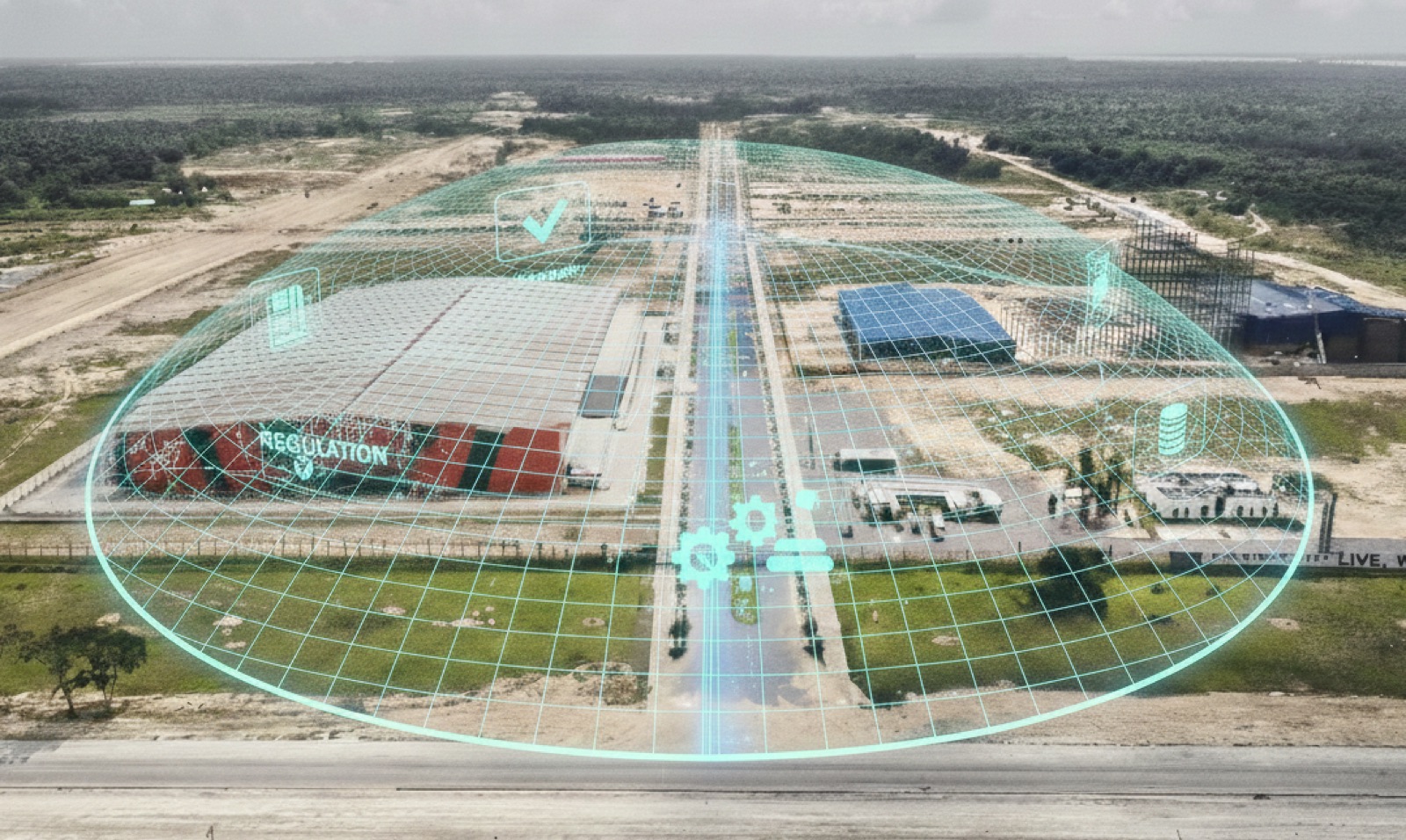
The solution to this dilemma—how to access Nigeria’s scale with South Africa’s stability—lies in a structural evolution: the rise of Digital Special Economic Zones (SEZs) and Digital Free Zones.
These zones are no longer just industrial parks for manufacturing; they have evolved into comprehensive "business jurisdictions" that function as embedded operating systems within a country. They allow companies to decouple their physical location from their regulatory reality.
This is the "Mitigated Entry Model". By anchoring operations in a structure like Itana in Nigeria, a company changes the fundamental physics of market entry.
1. The Treasury Airlock
The primary fear for any investor in Nigeria is liquidity—specifically, the ability to repatriate profits and manage FX volatility. Traditional entities are exposed to the extremes of currency swings and regulatory bureaucracies.
However, an SEZ structure acts as a treasury airlock. Companies operating within these zones can often transact in foreign currency, maintain multi-currency accounts, and enjoy 100% repatriation allowances. This effectively imports the financial freedom of a jurisdiction like Dubai or Delaware directly into Lagos. It allows the treasury function to operate with the predictability of a global hub while the commercial function attacks the local market.
2. Importing Governance
The Operating Playbook identifies "regulatory and bureaucratic hurdles" as a key challenge, citing fragmented governance and multiple clearance layers. SEZs solve this through "administrative efficiency."
Digital SEZs like Itana provide a "single-window" regulatory interface. Instead of navigating the myriad of regulators and various municipal bodies independently, the zone provides a consolidated regulatory framework. This is not merely a convenience; it is a form of risk management. It replaces the opacity of national bureaucracy with a "predictable administrative flow".
3. The Talent Paradox
Finally, the decision matrix must account for talent. The Playbook highlights that while Nigeria has a vast, English-speaking talent pool, there is a "brain drain" challenge. Conversely, bringing in expatriates involves navigating complex visa regimes and quotas.
Modern SEZ frameworks are beginning to address this by offering specialized immigration regimes and removing expatriate quota restrictions, effectively treating the zone as a talent harbor. This allows a headquarters to function as a true magnet for regional talent, unrestricted by the protean immigration policies of the host nation.
Conclusion: Geography is Strategy
Ultimately, the error many organizations make is treating the headquarters decision as a logistical one—a search for office space and reliable Wi-Fi. In reality, it is a structural decision that defines the company’s legal identity, tax exposure, and capital mobility.
The future of African expansion does not belong to those who wait for national systems to reach perfection. It belongs to those who utilize the "parallel infrastructure" available today. By leveraging digital jurisdictions and SEZs, companies can finally resolve the Headquarters Dilemma—securing the growth of the continent’s giants with the operational sanctity of a fortress.
The question is no longer "Which country is best?" but rather "Which structure allows us to operate in the market that matters?"
Strategic Implication: As you model your expansion, consider how the choice of jurisdiction impacts your treasury and compliance architecture. For a detailed breakdown of the decision matrix and the specific advantages of digital SEZs, refer to Chapter 1 of the [Operating Playbook].
👉🏽 Get started in Itana, a Special Economic Zone for Digital and Service-based Businesses