

Most UK and US founders assume the Nigerian entity question has one answer: incorporate a local Ltd, deal with the compliance, and get on with it. In practice, there are three structurally different choices, and the right one depends entirely on what you are trying to build.
Itana is Nigeria's digital special economic zone licensed by NEPZA for technology and professional services companies. It is the framework most UK and US founders end up using once they understand the full picture of operating in the country.
The first thing to settle is what your Nigerian operation actually is. Is Nigeria your end market, the place where your customers live and where revenue is generated in naira? Is it your operating base, the place where you build and deliver while revenue comes from elsewhere? Or is it both: a regional hub from which you plan to serve multiple African markets and raise capital to do it?
Each of those has a different structural answer. Getting this wrong early is expensive. Getting it right means your legal structure actively supports your commercial strategy rather than fighting against it.
Three Ways to Structure your Nigeria Operations
Option 1: Standard Nigerian Limited Liability Company
A Nigerian Ltd is the default incorporation route for companies whose primary commercial activity is selling into Nigeria. If you are contracting directly with Nigerian enterprise clients, issuing naira invoices at scale, or require a sector-specific operating licence (payments, lending, insurance, health), this is almost certainly a required component of your structure.
The compliance overhead is quite evident with Corporate Income Tax at 30% for large companies, VAT at 7.5%, and ongoing filing obligations. Capital repatriation is permitted but subject to procedural constraints that can tighten during periods of currency pressure. This is the right structure when Nigeria is your market.
Option 2: Itana Special Economic Zone Entity
An Itana-registered entity is the right structure when your revenue is denominated in GBP or USD, whether that means serving clients in the UK and US, operating as a regional hub billing African enterprise clients in hard currency, or using Nigeria as the headquarters from which you expand across the continent.
Inside the Itana zone, qualifying export activity may benefit from 0% corporate income tax and 0% VAT, capital repatriation rights and a streamlined incorporation process. Itana operates under a mandate from the Nigerian Federal Government as part of the country's digital free zone framework. That relationship gives members structured access to regulatory dialogue, which matters for any company whose product touches a licensed sector.
The setup cost incorporating in Itana is $2,000 and is typically completed within 48 hours. The annual operating license renewal is $1,150 from year two. Add legal costs for the transfer pricing agreement and intercompany service contract (typically a one-time exercise), and the full setup cost for most companies is well under $10,000.
Option 3: Dual Structure (Parent + Itana Entity)
For most UK and US companies entering Nigeria seriously, the answer is a combination: a parent entity in the home jurisdiction paired with an Itana-registered operating entity in Lagos. The two entities are legally distinct, with clearly defined roles and an inter-company service agreement governing the relationship between them.
This is the structure that gives you the widest strategic optionality, and it is where the rest of this article focuses.
How a Dual Structure Works in Practice
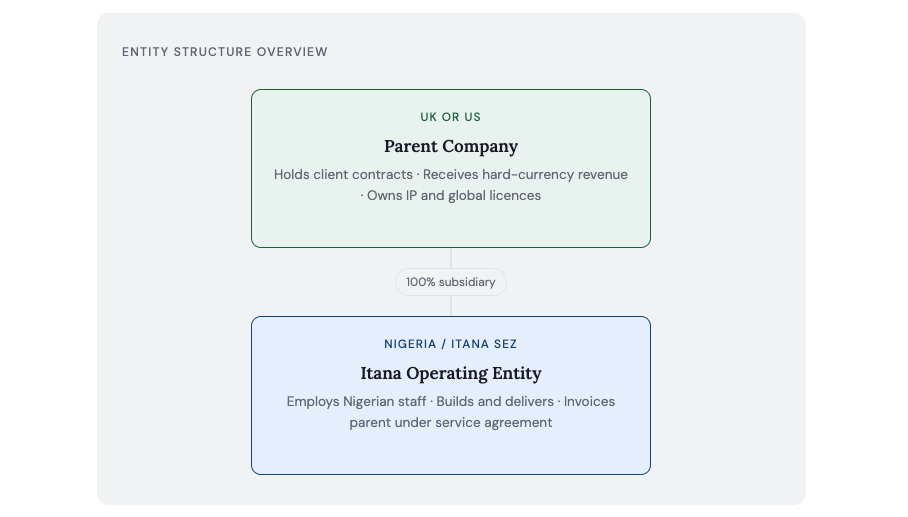
The parent entity holds everything that faces your clients and investors: contracts, revenue, IP, and any home-market regulatory registrations. The Itana entity does the operational work: employing Nigerian staff, building product, delivering services, and engaging with the Nigerian market. It invoices the parent for those services under a transfer pricing agreement. Payroll is in naira. Revenue stays upstream in hard currency until it is needed locally.
Four Reasons Founders Choose a Dual Structure, and Which Applies to You
Sell into Nigerian and African enterprise with a credible local entity
A common point of friction for UK and US companies is deals stalling at the legal review stage. Nigerian enterprise buyers (banks, telecoms, FMCGs, conglomerates) require a local counterparty for procurement, and a foreign entity contracting from London or New York often cannot clear that hurdle. An Itana-registered entity gives you a Nigerian legal presence and a local bank account without the full compliance overhead of a domestic Ltd. For companies billing in USD across multiple African markets, it is materially cleaner than a domestic entity while still satisfying the local presence requirement that procurement teams look for.
Best suited to: B2B SaaS, fintech infrastructure, ICT services, and professional services firms.
Access Nigerian government contracts
Foreign companies cannot bid directly on most Nigerian public sector contracts. Government procurement (federal ministries, agencies, parastatals, state-level bodies) typically requires a locally registered entity as the contracting party. The Itana entity provides that registration. Beyond the legal requirement, Itana's position within the NEPZA-licensed digital free zone framework gives members a level of regulatory visibility and institutional credibility that a standalone domestic Ltd does not carry. For companies targeting public sector digitisation (government IT, infrastructure, energy, compliance tooling), this is a structural advantage that directly affects whether you can get in the room.
Best suited to: ICT and enterprise software providers, energy and infrastructure companies, professional services firms targeting public sector clients.
Use Nigeria as a regional HQ for West Africa
Lagos is the commercial and financial capital of West Africa. Nigeria's diplomatic footprint, business networks, and air connectivity make it the natural operating base for companies that intend to serve Ghana, Côte d'Ivoire, Senegal, Kenya, and beyond. The Itana structure handles this cleanly: your regional clients are billed in hard currency, operational costs sit in the Lagos entity in naira, surplus repatriates in full, and you are operating from a jurisdiction that African counterparties understand and respect. As AfCFTA (the African Continental Free Trade Area) matures, a Nigerian domicile is increasingly positioned as a gateway to the continent, not just a single-market play.
Best suited to: Companies with pan-African ambitions, energy and infrastructure businesses, regional service providers, logistics and supply chain platforms.
Build an engineering or operations team in Lagos
Running Lagos payroll from a UK or US P&L creates a currency mismatch that compounds over time. Through the Itana entity, you employ Nigerian staff locally under Nigerian law, pay them competitively in naira, and keep the FX exposure where it belongs. Nigeria has one of Africa's deepest pools of software engineers, product managers, and technical operators. The cost differential versus equivalent UK or US hires is real at senior levels, but it is only sustainable if you invest in compensation, structure, and retention. Engineers who benchmark against global remote roles will leave if you treat this as a cost-cutting exercise.
Best suited to: SaaS companies, engineering-led services businesses, and product teams scaling capacity.
What Each Entity is Responsible For, and Why The Boundary Matters
The most common structural mistake is allowing the boundary between entities to blur. These boundaries are not just legal hygiene. They preserve the tax and FX advantages of the structure and make it defensible to auditors, investors, and regulators on both sides. There is one important exception: where the Itana entity is the contracting party for Nigerian or regional clients (in enterprise sales or government procurement), it holds those contracts directly. The revenue flow and tax treatment differ in that scenario and should be structured with specific advice.
When you also need a Nigerian Ltd
If your product requires a sector-specific operating licence (payments, lending, insurance, data processing at scale), a domestic Nigerian Ltd may be required in addition to your Itana entity, not instead of it. The Itana entity handles your operational and employment structure; the Nigerian Ltd holds the regulated license. Your advisor can help you determine whether a dual Nigerian entity structure is necessary for your model.
Let’s Review your Specific Structure
The right setup depends on what you are building, where your revenue comes from, and what you plan to do in Nigeria over the next three years. A 30-minute call is the fastest way to get a clear answer and to understand exactly what incorporation, ongoing costs, and operational setup would look like for your company.