
A decade ago, the central challenge for African creative industries was distribution: could the continent command global attention? Today, African music fills international arenas, artists command massive followings, and movies stream on global platforms. In an internet-native economy, an Africa-born track, recipe, or fashion line finds an international audience overnight. Yet this success uncovers a sobering reality: an audience does not always translate to a scalable generational business.
A song can go viral worldwide while the business behind it stays small and local. An artist can pass a billion streams without building anything that lasts beyond one release. Creating cultural value and capturing economic value are fundamentally different tasks. The first depends on audience resonance; the second depends on how a business is structured and owned. Sub-Saharan Africa was among the fastest-growing recorded-music regions in 2025, expanding 15.2% to $120 million, according to IFPI. Yet that is still a tiny sliver of a $31.7 billion global market. African cultural reach has grown much faster than the businesses built to capture it.
Translating audience attention into generational value requires a functional operational stack: practical IP enforcement, multi-currency banking, and clear cross-border rules. The strategic priority for the next decade is whether Africa can build the commercial platforms needed to retain the value of its output. Creative output must be treated as a structured asset. A song anchors a longer chain of value: master rights, publishing royalties, trademarks, sync licensing, and catalog value. An event can become a repeatable franchise, and a game can become a software portfolio. Global media companies operate this way—aggregating IP, organizing rights, building repeatable systems, and reinvesting cash flows. Between 2020 and 2024, more than $8 billion in music-royalty securitization was issued on the strength of that model.
Building a scalable creative business across African markets remains hard due to fractured banking systems, conflicting tax policies, and currency controls. Launching in a new country often means duplicating legal and administrative work from scratch. While a digital file moves across borders in seconds, the royalty, tax, and licensing lags behind at the border. Culture expanded faster than the legal frameworks built to support it.
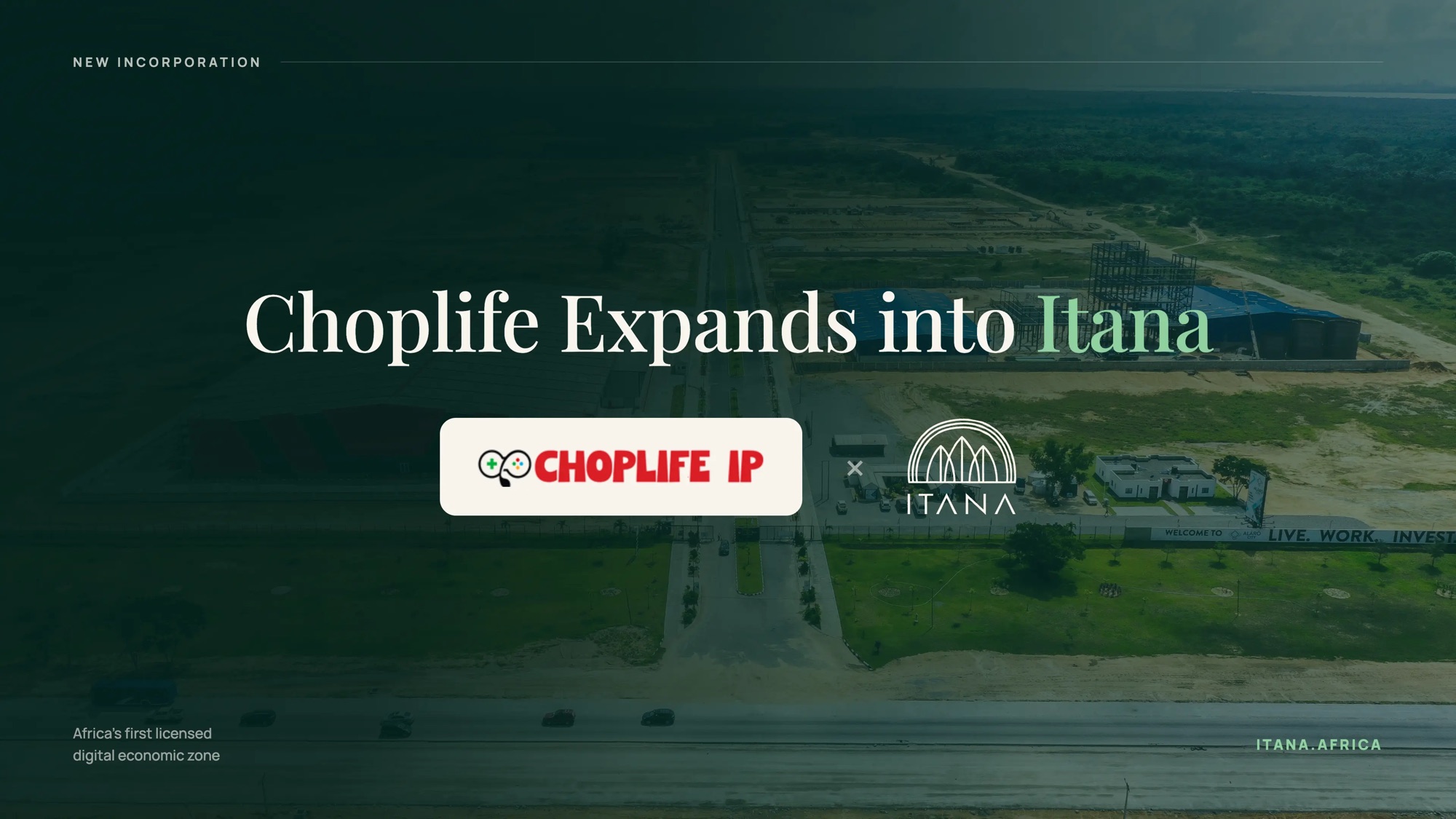
Choplife is one of the growing number of ventures trying to bridge this gap. Founded by globally recognized artist and entrepreneur Oluwatosin “Mr Eazi” Ajibade, ChopLife sits at the intersection of music, film, sports, media, technology, and gaming. Bringing franchises like Detty Rave and 1v1 Africa under shared corporate management, Choplife creates and commercializes IP across these connected spaces. Instead of relying on isolated releases, it holds intellectual property within a unified ecosystem, cross-leveraging audiences and building proprietary technology.
A multi-market footprint across 11 African markets usually forces creative firms to choose between scattered local subsidiaries and offshore entities in Delaware or London. Choplife instead centralized its corporate structure inside Africa by expanding into the Itana Digital Special Economic Zone. As a NEPZA-licensed digital free zone backed by the Africa Finance Corporation (AFC),Itana offers full remote business registration with a streamlined process. Choplife uses Itana as its central holding, governance, and treasury hub to manage IP, route royalties across borders, and fund new ventures, gaining multi-currency banking, guaranteed capital repatriation, simplified compliance, and competitive tax terms designed for digital and IP-driven ventures.
In joining Itana, Choplife operates alongside a growing ecosystem of high-growth technology companies, including Reliance Infosystems, Circular Energy, and leading AI platforms like MasteryHive, Udu Technologies, and Yamify. For Itana, this partnership proves that Africa’s digital economy can provide the operational clarity, asset protection, and legal stability that fast-growing creative groups need. It resolves the administrative and financial fragmentation that has held creative growth back. Hosting Choplife demonstrates that purpose-built commercial zones can unlock capital, simplify expansion, and keep high-value intellectual property owned on the continent.
The early years of Africa’s creative growth focused on global visibility through stream counts, social followings, and international tours. The next phase depends on operational maturity. Africa’s creative economy will expand not merely by producing another global hit, but by building commercial companies capable of turning hits into assets, assets into portfolios, and portfolios into generational businesses.